
(Please note: Sally Denshire is a member of the Riparian group and a friend. She will be referred to here by her first name. This is not a review but a personal reflection on an exhibition that feels … personal. We would welcome the thoughts of others in the comments section.)
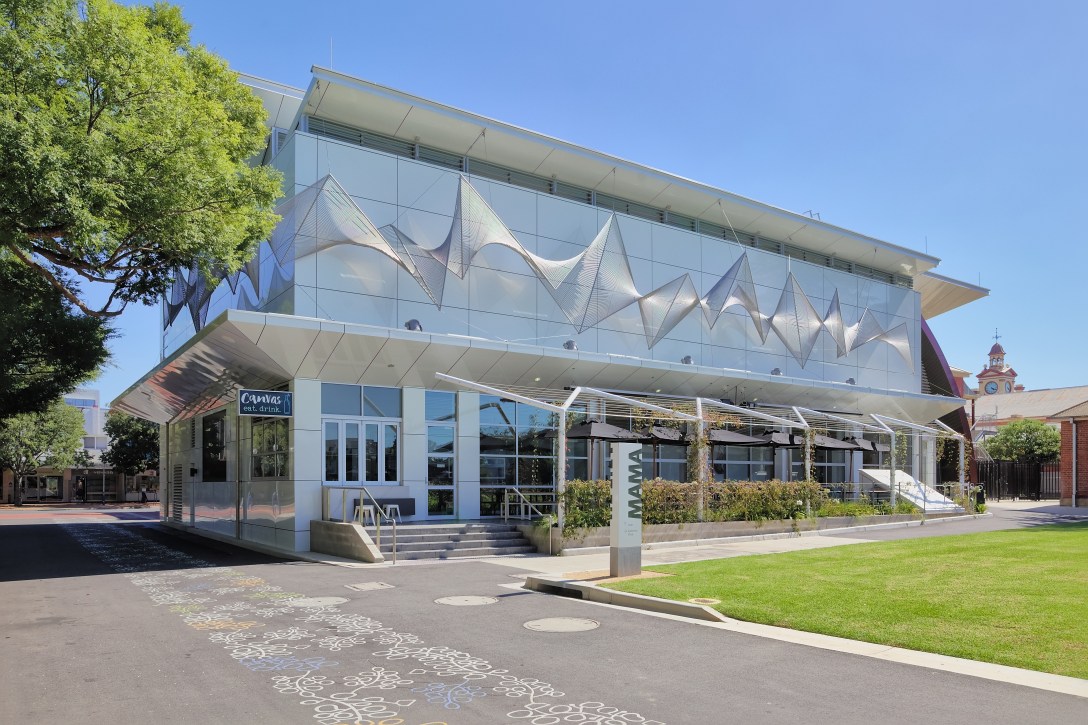
At the door to the atrium I pause, with the sense the new gallery often gives me, unspoken and almost imperceptible, a need to brace myself, as if I might have to explain my presence here. MAMA’s atrium is a spectacular space. It demands large, significant art and the art, in turn, demands attention. I find myself hurrying through.
But the Joss Family Galleries, the setting for Sally Denshire’s exhibition (P)recollection, are on a more human scale. Here I feel something kinder.
And something unusual.
The plaque at the entrance explains that (P)recollection “offers a mapping of collection practices pre-dating the opening of Murray Art Museum Albury (MAMA) and threading cultural and civic stories with (Sally’s) own personal narratives and community connections.”
The walls have been painted a distinctive, embracing green. In her opening address Sally spoke of the care with which she and gallery staff chose the colour.
Another surprise. Immediately to the left of the entrance there are portraits of two Albury dignitaries (I think they would enjoy the word): Alfred Waugh Esquire (c1925) by an artist “once known”, and Alderman C. E. Bunton (1950) by Jack Bennett. Waugh looks self-satisfied and a little severe, and Bunton rather melancholic.
Now I am curious. These portraits are certainly representative of their genre and era, but I suspect a little curatorial mischief. What could they be doing here, slightly discordant, surveying this room of art? Alfred and C.E. look as if they might be wondering the same.
Together we study the first room of (P)recollection.
Near the portraits are five landscapes of the local area by H. G. Twomey and Auriel Alford, skilfully done, quiet, gorgeous, performing what might be a traditional task of art – showing us beauty that has always been right in front of us.
There is more familiar loveliness in “Japonica” (1962) by Alan Thomas Bernaldo and here I get a first hint of what (P)recollection might really be about.
In a plaque and in a nearby case, Sally draws connections from “Japonica” to her own memories, and to art created by her children. It is novel to me, to feel the curator’s presence so directly. She seems to be saying that a work of art is not just an object on a wall. The art takes place in connections, in our responses, yours and mine, in our flickering impressions, feelings, memories. We the audience are central.
Maybe this is the purpose of Alfred Waugh and C.E. Bunton. They are here to watch us.
In the second room we are reminded of the value of something else. There are names from the past: a glorious vase by Tim Moorhead. Arboreta 1973-2012 (2013) by Mary-Jane Griggs repays long thoughtful looking, continually revealing new ideas, new sensations, new beauty.
A nearby case holds photographs and letters, showing the work that was done to drive and develop our former Albury Regional Art Gallery and the tireless dedication of Audray Banfield. Others equally determined. There seemed, in those early days, to be a great sense of ownership.
It is warming. Here are faces and hairstyles from the past, the staircase at the centre of the old gallery, the courtyard so glamorous in its day, so arty.
This is the art gallery of Albury. It is ours.
I brush aside the thought that we have lost something. Sally wouldn’t think so. She would remind us of the people of MAMA, their helpfulness and hard work, their efforts to draw us in to workshops and talks and events, their determination to nurture local artists and curators.
And, after all, things have to move on. Everyone in these grainy photographs would agree with that.
On the rear wall is the vivid, sharply-observed photograph Something More (1989), by Tracey Moffat. I remember our delight when it was acquired.
Mary-Jane is in it. One of us has broken through the magic window and entered that other world. It isn’t another world. It is us.
We are art.
Around the room there are other prominent names, significant works, and here in the context provided by Sally, we are reminded of the care and effort taken in acquiring, showing and preserving these important pieces.
We the people of Albury need to come in and see these.
And now here is Sally again, more generous intimacy, three kids on a couch playing dress-ups, Sally’s love for the photographer Olive Cotton, her poem, responding personally, inviting us to do the same.
On the way out there is a last surprise, apropos of nothing, a kid in a paper hat, a vulnerable happy human, Sally winking at me as we say goodbye.
So now I am smiling. I walk through the echoing atrium, feeling enriched and included and proud.
I glance at the politically significant work by the artist from Paris, and have a subversive thought of my own. Yeah, well done to you, but there is more than one important person here today.
Albury’s art gallery has always been for and of its people. Thank you Sally for you wisdom, humour and insight and, for me at least, for reminding me that this gallery is ours, for knowing: art is us.
And thank you MAMA for an inspired programme. More local curators please.
 Riparian
Thank you Joanna Baker, you have captured many of the feelings I had as I visited the P(recollection) exhibition, though my responses did evolve each of the three times I visited.
And thank you Sally Denshire, curator, for drawing me back again and again.
I love how the visual images sit with the texts in these calm rooms. As this is a blog of writers, I must add, it is the narrative that attracted me, the feeling that I was walking through a history of many layers, with threads tugging at many intriguing stories.
Congratulations!
LikeLike