
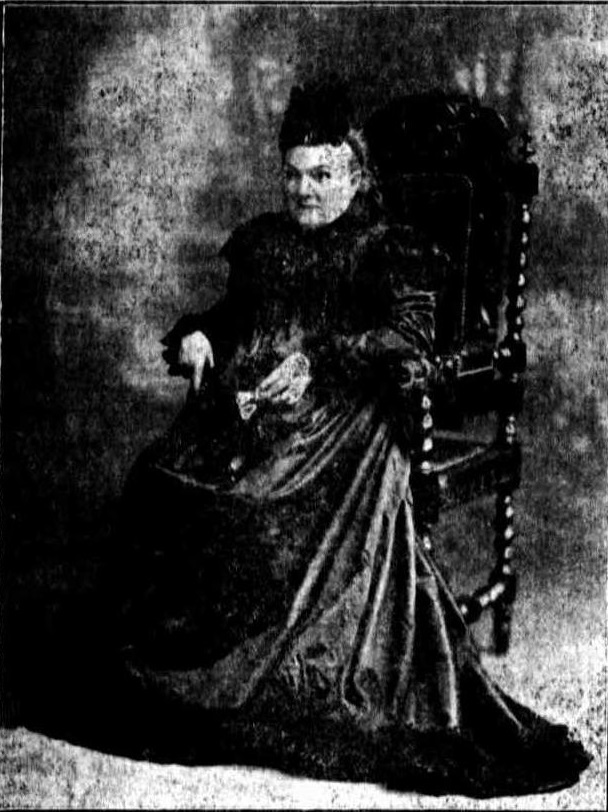
Annie Bellow McDonald was born at Rockharshall, Ireland in 1838, her father Andrew, a captain, her mother Margaret. She boasted in 1919 that through her mother’s line she was from the celebrated Bellew family of Barmeath Castle, near Dublin, while on her father’s side she descended from the MacDonalds, known as the ‘Lords of the Isles,’ of Dunluce Castle on the coast of Antrim. She was educated in languages and sciences as well as other subjects of ‘refinement’ and ‘usefulness.’
The records show she married Torrens McCann in 1856, when aged eighteen. They went on to have nine children; three deceased in childhood. A not unusual story for the times.
The McCanns migrated to Australia in 1858, settling to run a hotel at Snowy Creek which was a goldfield seven kilometres from Mitta Mitta and seventy-five from Wodonga. The area was later called Granite Flat and sits in the Shire of Buloke. Bailliere’s Victorian Gazetteer (1865) recorded one hotel in the town. The McCanns called it ‘Rockalpine House,’ and it no longer stands having burnt down in a bushfire after the family’s time, in 1939. Annie is also recorded as having given lessons to local children.
The only unusual part of the story so far: the McCanns were not there primarily for the gold. There was an influx of gold-fevered prospectors in that period, as many as a thousand people, including a fair number of Chinese.
It is at this point in her life that Annie McCann’s name entered the archive of the State Botanical Collection at the Royal Botanic Gardens Victoria (MEL), a collection of 1.5 million dried plants, algae & fungi specimens from around the world, mostly Australian, with an emphasis on the flora of Victoria. More than 200 of Annie McCann’s specimens can be found in the National Herbarium of Victoria.
She was one of Government Botanist Ferdinand Mueller’s female plant collectors, her focus on liverworts and mosses. She contributing types of Frullania hamaticoma Steph. (1889), Frullania. victoriensis Steph. (1910), Zygodon remotidens Müll.Hal. (1898), Orthotrichum acroblepharis Müll.Hal. (1898). Two letters from Annie McCann to Ferdinand Mueller survive.
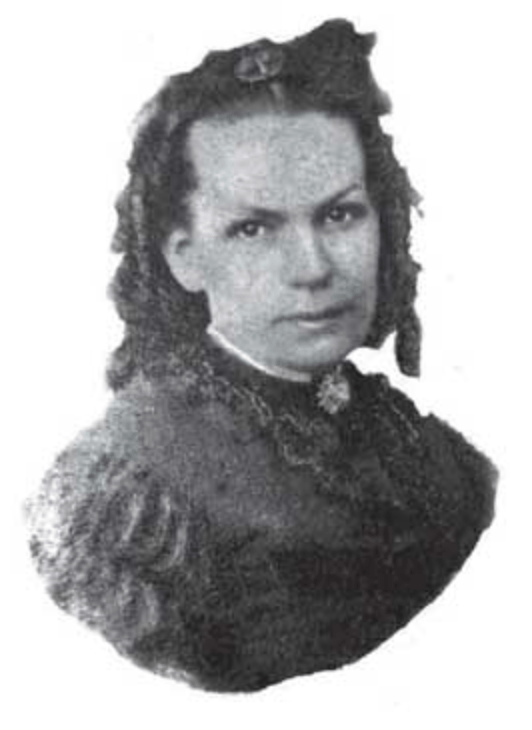
This is an unusual story then. Whatever the bare bones of biography suggested it expands to a delight in discovering new liverworts and mosses while tramping through Buffalo Range, Snowy Creek, Mount Hotham, and the Ovens River. There is a photograph in Sara Maroske and Alison Vaughan article ‘Ferdinand Mueller’s female plant collectors: a biographical register,’ Muelleria Vol.32, 2014, which suggests the wife and mother in the ringlets, ribbons and frills common in the nineteenth century, and the botanical collector in the direct, uncompromising gaze into the lens.
After her husband died, Annie McCann crossed the border and lived in Albury, NSW. She seems to have called her house in Griffith Street ‘Rockalpine’ as she did her first home at Snowy Creek. She worked as a teacher and postmistress and died in Albury aged 86.
In 1919 The Border Morning Mail and Riverina Times reported on an exhibition of her art at the Albury Show under the title ‘Albury’s Octogenarian Artist.’ The review is glowing. She was known to work in watercolours and also called her embroidered wildflowers ‘needle painting.’ The journalist was impressed not only by her artwork but also by her handmade Christmas cards with unique verses, printed in gold in Melbourne.
The article contains a sketch of her life, in which it is observed that ‘Mrs McCann seems to have been a dreamy poetess from childhood’ and claims she was ‘the first Victorian lady to write and publish an extensive volume of poetry.’ This refers to her 1888 collection.
When Annie McCann was 50 years old, George Robertson of Melbourne, publisher, issued a book of 300 pages titled The poetical works of Mrs Torrens M’Cann. Government Botanist Ferdinand Mueller gave his sister Clara, a fellow MEL specimen collector, a copy. The National Library of Australia houses a presentation copy inscribed in Annie McCann’s own hand on the fly leaf to the Countess of Hopetoun on her return to Victoria dated 24 May 1891.
Piece by piece, this story found in the archives truly becomes one of a life less ordinary.
The National Library of Australia sums up Annie McCann’s occupations as flora collector; poet; artist. Of these, it can be argued, her poetry made her most proud.
She is buried in the Albury Pioneer Cemetery under a modernist black headstone along with five others of the McCann family, their names etched in the stone. She is first, listed – In Loving Memory – as Annie McD. (Poetess) 1924.

Sources:
https://www.victorianplaces.com.au/granite-flat
https://www.anbg.gov.au/biography/mccann-annie-bellew.html
https://catalogue.nla.gov.au/Record/1162579
https://www.wikitree.com/wiki/Müller-3761
https://www.eoas.info/biogs/P006108b.htm
https://trove.nla.gov.au/newspaper/article/109861628
Feature Image: A black and white portrait of Annie Bellew McCann, ‘Albury’s Octogenarian Artist.’ The Border Morning Mail and Riverina Times, 13 September, 1919.
 Riparian

Very interesting, thanks. Looks like a very recent memorial
LikeLiked by 1 person
I’m not good with dating grave memorials but it would be interesting to know when it was erected (after 1969) and whether there are still members of the family in Albury.
The nature of research – there is always more to find out!
LikeLike
This is exactly one of the reasons I subscribed to The Riparian! What a wonderful account of an extraordinary and inspiring woman Jane! Does the Griffith St house remain? I wonder if the inhabitants know how fabulous the original owner was. Thanks for sharing this.
LikeLike
I’ve wondered the same thing Wendy. I should walk slowly down Griffith Street trying to see house names! If anyone in Griffith Street reading this knows the history of their house I’d love to hear!
LikeLike